Election security worldwide
The question of election fraud is a worldwide concern, but the use of electronic voting machines introduced shortly after the………more...
Read more...

The question of election fraud is a worldwide concern, but the use of electronic voting machines introduced shortly after the………more...

When it comes to election security, the technology we use to vote and count those votes is not the problem. The problem is how naive we are.
Election security has been at the forefront of daily news cycles for more a decade. The concerns about illicit use of technology to input and count the votes turned out to be largely overblown. Every U.S. state other than the Commonwealth of Louisiana, uses paper ballots, matching the practice of every other western democracy. Lawsuits have bankrupted people and organizations claiming the technology was changing votes. Those that have complained the loudest about election interference are now facing prosecution for the crimes.
Now the tech focus is on the use of artificial Intelligence to create deepfake video and audio. A recent pitch from Surfshark,

The cybersecurity industry seems addicted to research but isn’t all that good at it. Mining the massive amount of data produced is daunting but crucial to everyone.
Surveys and studies are an important part of marketing form the cybersecurity industry. Cyber Protection magazine receives a lot of them. We read them all. In the two months before the RSA Conference, more than one a day came into our inbox. However, they are not a great source of independent data and insight.
Ignoring the cherry-picked data highlighting a particular company’s product or service, there are a few nuggets that, taken together, produce some interesting insights. Out of 60+ reports, we took a pass on any that were repetitive, were suspect methodologically, or effectively plagiarized from another source. We chose to look at seven with a solid methodology, representation of industry-wide concerns, and originality. The reports came from Dynatrace, Black Kite, SlashNext, Metomic, Originality AI, Logicgate, and Sophos. We found three common themes: The impact of AI on security, government regulation compliance, and understanding of security concerns on the C-suites and board levels.
Understanding security issues.
Almost every study has a common complaint. CISOs say application security is a blind spot at the CEO and board levels. They say increasing the visibility of their CEO and board into application security risk is urgently needed to enable more informed decisions to strengthen defenses.
However, Dynatrace’s study said CISOs fail to provide the C-suite and board members with clear insight into their organization’s application security risk posture. “This leaves executives blind to the potential effect of vulnerabilities and makes it difficult to make informed decisions to protect the organization from operational, financial, and reputational damage.”
Recent news shows the study may have a point. Marriott Hotels admitted that a 2018 breach was the result of inadequate encryption of customer data. In 2018 the company claimed their data was protected by 128-bit AES encryption when customer identity was only protected by an outdated hashing protocol. One can imagine the discussion between the CEO and the IT department:
CEO: is our data encrypted?
IT manager: Yeah, sort of.
CEO: OK, good enough
If the CEO doesn’t understand the difference between a hash and AES encryption, that’s a problem.
And there many be evidence that ignorance is widespread. Apricorn reported that the number of encrypted devices in surveyed companies had dropped from 80 percent to 20 percent between 2022 and 2023. Some of that could be attributed to work-from-home (WFH) growth in companies. It is also likely that companies over-reported what was encrypted simply because they did not understand what “encryption” meant. Once they learned the meaning, adjustments were made.
That lack of a foundational security technology could be a reason for the devastating growth in ransomware in the past two years.

Our chief editor Lou Covey participated in the Cyber News Show for Infosec.live…… Free Membership Required You must be amore...

Cyber Protection Magazine posted a long article about Google’s decision to start de-listing California-based newspapers. We strove to be as objective as possible and present both sides of the argument, but we did say that the opponents were missing the point, hoping that the point would be obvious in the discussion. Here, however, we want to shed objectivity and make the point clear.
Google’s move, generously described, is a preemptive response to California’s Journalism Preservation Act (AB 886) that has yet to pass the Senate. The act will require Google to sit down and negotiate with California publishers over the fair price of publishing content from those media sites.
Note that the bill is not mandating a price. It is mandating a negotiation. That changes the nature of the discussion.

Our current election season faces the same problems as in 2016 and 2020. Foreign adversaries are interfering with the election process. This time we know it’s happening we know where it’s coming from and we have ways of dealing with it. The question is, is it enough?
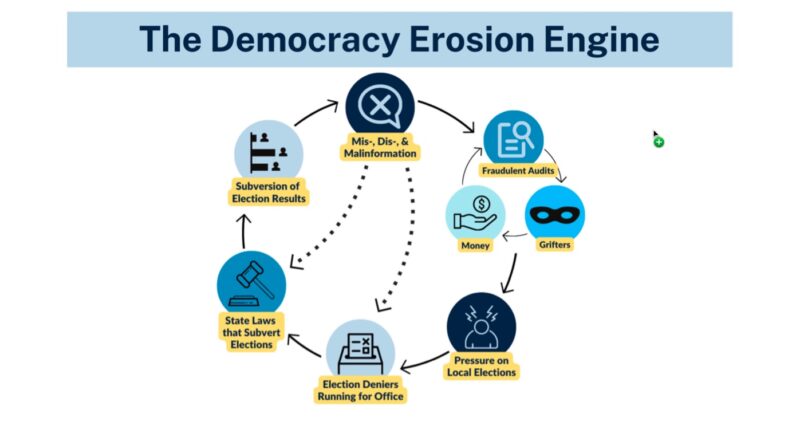
Election security has been a significant news story for half a decade, much of it focused on the technology of voting. The focus should be on people, however, specifically the critics of election security.
Read more...