cybercrime

Elder fraud festers out of control

As legislatures around the world try to get a handle on the growth of ransomware, another category of cybercrime is festering out of control: Elder fraud.
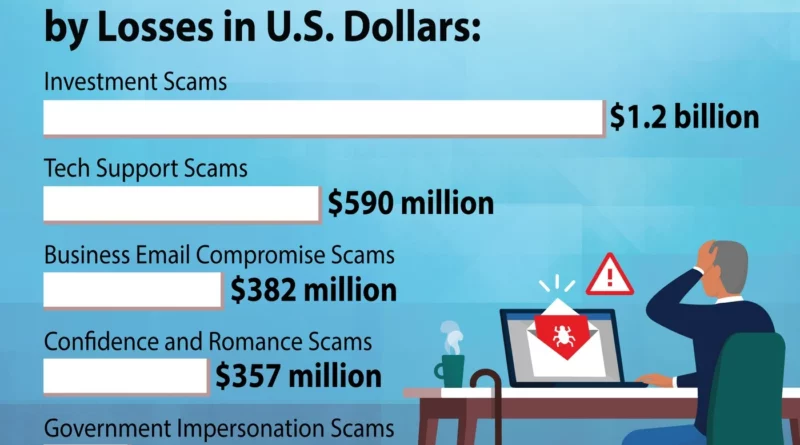
The FBI’s Internet Crime Complaint Center (IC3) reported more than 100,000 people in the US, 60 years and older, lost $3.4 billion total to digital scams. The IC3 pointed out that the elderly are half as likely to report a loss. So the actual crimes and losses are probably much higher.

In contrast, the total ransomware payouts last year from reporting companies was $1.1 billion according to Chainanalysis. While the total number of fraud reports to the IC3 appears to have leveled off after years of growth, elder fraud increased by 14 percent year on year.

“Combatting the financial exploitation of those over 60 years of age continues to be a priority of the FBI,” wrote FBI Assistant Director Michael D. Nordwall, who leads the Bureau’s Criminal Investigative Division, in the report. “Along with our partners, we continually work to aid victims and to identify and investigate the individuals and criminal organizations that perpetrate these schemes and target the elderly.” 

Who is vulnerable?

Membership Required

You must be a member to access this content.

View Membership Levels

Already a member? Log in here
Read more...

RSAC Reporter’s Notebook: Change is coming

The cybersecurity industry is just absolute chaos, and rightly so.  This is the industry charged with plugging dikes during the Class-5 hurricane that the internet seems to be today.  Nowhere is that chaos more evident than at RSAC just from a marketing perspective. Everyone has “ground-breaking”, “industry-leading”, and “first ever” product offerings and this year was no different.  But if you can look past the Macho-man impersonations, Formula One cars, and the mesmerizing miasma of the website and show floor, you can see an order forming in the chaos. Change is coming.

Back to step one

RSA CEO Rohit Ghai, said we have missed a step in AI development.  “We’ve seen it first as a co-pilot alongside of a human pilot and then see it taking over flying the plane.”  He said the first step is making it an advanced cockpit making it easier for less trained and experienced people to do the work.  He pointed out that cybersecurity is an industry with negative employment making it difficult to find experienced technicians to do the work.

Last year, any discussion of ethical development was met with confused stares. This year, the need for ethical AI development is taken seriously but few can see a profit in it. Cybersecurity VC Rob Ackerman (DataTribe) and Carmen Marsh, CEO of the United Cybersecurity Alliance, were open to suggestions,

“From the perspective of (companies like OpenAI), I understand the reasons to go as fast as they can to develop a true artificial intelligence, the question is, who are the people in the room guiding the process?” said Ackerman. “Once you get a diverse set of advisors working on the problem, then you do the best you can to create something ethical.  But right now, we aren’t even doing the best we can.”

Membership Required

You must be a member to access this content.

View Membership Levels

Already a member? Log in here
Read more...

How Do You Insure an Unpredictable Risk?

From our Cyber Insurance Issue: In today’s interconnected digital world, there is no such thing as an “unconnected” business.   That means for most that the extent of their online exposure will include running a calculated risk of becoming the victim of a cyber-attack because that event risk can never be zero. Or does i

Membership Required

You must be a member to access this content.

View Membership Levels

Already a member? Log in here
Read more...

Third-party security is almost impossible

There are many themes arising for the RSA Conference next week including tools and services to protect against originating with unsecured third parties in the supply chain. That is a crucial issue in every industry especially with almost every company doing business with a supplier in the cloud. But the scope of the problem is almost impossible to resolve. The reasons are myriad.

With every Fortune 1000 business and government agency doing business with tens of thousands of third-party suppliers, the odds of finding one chink in the security protocols are very good for the criminals and state actors looking to do damage.

Social engineering can easily bypass the strongest technical defenses. It only takes a single lapse in digital hygiene to open the door to man-in-the-middle attacks, invite malware injections, and launch credential stuffing. It is also the favorite strategy of ransomware gangs.

Ransomware grabs headlines and remains highly lucrative for ransomware gangs. When compared to other forms of cybercrime, however, ransomware is really a minor issue. There are more than 33 million small businesses (under $100 million in revenue) operating in the United States alone representing 99 percent of all businesses. However, according to a study produced by the Black Kite Research and Intelligence Team, less than 5000 of them experienced a successful ransomware attack in the last 12 months...

Membership Required

You must be a member to access this content.

View Membership Levels

Already a member? Log in here
Read more...

GDPR and the need for Cyber Insurance in Europe

GDPR, with its rigorous data protection standards and hefty fines for non-compliance, has heightened awareness about data privacy and reshaped the demand for cyber insurance.

Cyber insurance offers a financial safety net that can help organisations mitigate the potentially devastating financial impacts of cyber incidents, including data breaches, ransomware attacks, and other forms of cybercrime.

Organisations should consider cyber insurance as an integral component of their risk management strategy, particularly given the escalating landscape of cyber threats and regulatory requirements.

Membership Required

You must be a member to access this content.

View Membership Levels

Already a member? Log in here
Read more...

Murky third-party agreements weaken healthcare privacy controls

The healthcare industry is a vulnerable target of cybercriminals, but not for the reasons most business sectors are. Between 80 and 90 percent of all cybercrime results from people not following basic cyber hygiene practices, but in healthcare criminals gain access to information through infrastructure weaknesses and the murky third-party agreements.

Membership Required

You must be a member to access this content.

View Membership Levels

Already a member? Log in here
Read more...